Below is the paper I delivered to the one day conference More Sounds, More Personalities, British PostMinimalism 1979-97‘ at Goldsmiths College, University of London, 18th September 2024.

All but one of the composing and performing group 3 or 4 Composers are taking part in today’s conference. My title slide is a drawing by the one who isn’t here today – Simon Rackham – who created images for many of our flyers and programmes.
In early 1989 a group of musicians were drinking coffee in the ICA bar. We were approached by Lois Keidan, then programmer of the ICA theatre. She wanted to know if we had any thoughts about filling a hole in her schedule coming up that May. This was the moment that 3 or 4 Composers was born and the event we presented on 30th May 1989 – ‘3 or 4 Composers Grapple with the Notion of English Song’ – was the beginning of 10 years of fruitful collaboration with each other and with other artists.
The group comprised me, Helen Ottaway, (ex Goldsmiths’ music student and founder member of Regular Music with Jeremy Peyton Jones and Andrew Poppy); Jocelyn Pook (ex Guildhall student who had worked with Jeremy Peyton Jones as a musician for Impact Theatre’s A Place in Europe); Melanie Pappenheim (ex King’s student who had worked with Jeremy Peyton Jones on Lumiere & Son Theatre Company’s show Panic); Simon Rackham (painter, composer and French horn player – ex R.A.M. student who played with Melanie in the band Shopping Trolley) and Laurence Crane (ex Nottingham University student, founder and co-director of the minimal music group The Wink).
Lois Keidan went on to help establish ‘The New Collaborations Fund’ in the Combined Arts Department at the Arts Council which she said to the assembled composers and performers ‘will be for people like you’. That fund has indeed been a huge support for people like us for quite a few decades.
All of us went on to have individual and distinctive careers in music but I’d like to tell the story of our early experiments together in collaborative and site specific music, installation and music theatre.
Between 1989 and 1998, 3 or 4 Composers collaborated with visual artists, flower arrangers, theatre makers, instrument makers, fire artists and engineers. We worked with other musicians, sound designers, technicians and producers to create work for a wide range of venues and sites.
In the 1980s and 90s there was a constant criss-crossing between disciplines and a rich array of collaborative work involving music, theatre, dance and fine art. Some of the members of 3 or 4 Composers met through working in experimental theatre. Singer Melanie and French horn player Simon met while working on a theatre piece at Dartington. Here they also met Barbara Hook who contributed costumes for 3 or 4 Composers’ early performances. I met both Jocelyn and Melanie through Jeremy Peyton Jones when he and they were working with Impact Theatre Company and Lumiere and Son. Jeremy was a link between worlds and between people and eventually both Jocelyn and Melanie were part of Regular Music too.
Melanie and Laurence had met through their respective university friends James Duke and Andrew Renton – around the time that 3 or 4 Composers was formed, Larry wrote pieces about both of these friends: 2 six minute piano pieces James Duke son of John Duke and Andrew Renton becomes an international art critic. Melanie also introduced Larry and Simon.
My introduction to Simon was through his suite of piano pieces ‘A Small Selection of Cheeses’. The Cheeses had been performed at a concert at the Royal Academy. When the original pianist wasn’t available for a second performance Melanie suggested Simon ask me to stand in. So I performed Simon’s ‘Small Selection of Cheeses’ for the first time at Lauderdale house in Highgate at a concert of work by Laurence and Simon promoted by Larry’s Extremely Big Music. And this was also how I met Laurence. Simon went on to write many other piano works for me and I became as Larry describes ‘ the principal interpreter of Simon’s piano music’.
By 1988 we all knew each other and as I said in early 1989 we were drinking coffee in the ICA bar together. I really can’t overplay the importance of the ICA. They had a great series called Musica which featured all the new music ensembles. At the same time the theatre was hosting 3 and 4 week runs of experimental theatre shows.
The name 3 or 4 Composers came about because although Jocelyn, Laurence and Simon were all already composing and having work performed, I was, at that point, quite a sought after pianist but not a composer. This was an opportunity for me to compose but there was a touch of uncertainly – hence the name. Melanie was the central performer but she was also an active collaborator with composers she worked with and often could be described as a co-composer. And she has since worked as a composer. In a recent conversation with Laurence it seems he thought perhaps he was the or 4 as he bowed out of involvement in the more theatrical and installation-based work we made.
3 OR 4 COMPOSERS GRAPPLE WITH THE NOTION OF ENGLISH SONG

We were interested in new ways of performing. Right from the beginning there was a sense of irony and a theatricality to our performances. The title for our first concert ‘ 3 or 4 Composers Grapple with the notion of English Song’ was, as reported in the Time Out listing, our attempt to find a direction for this well loved genre in the 1990s. It was also an example of Larry’s tongue in cheek irreverence and his talent for witty and ironic titles.
That first concert at the ICA, which we also took to the National Review of Live Art in Glasgow, featured an arrangement of 100 roses, costumes, slide projections and theatre lighting.
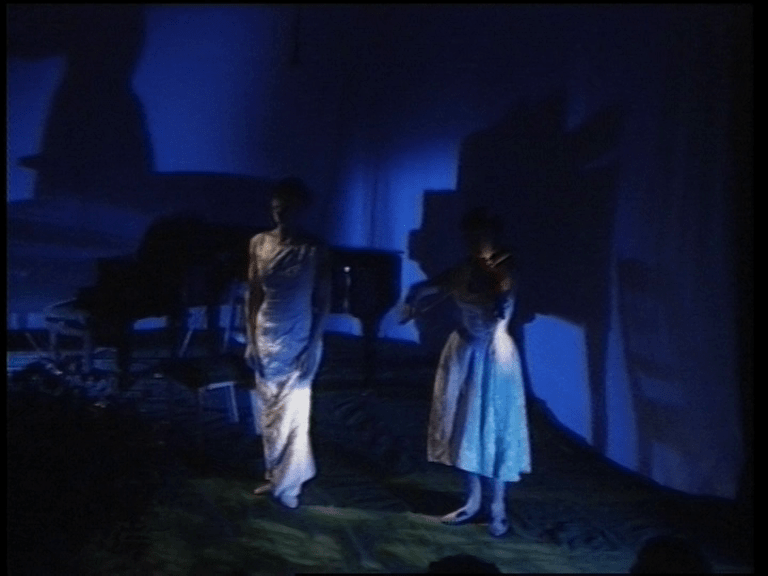
The programme included song cycles by Jocelyn, Simon and Laurence and an instrumental piece, my first composition, Mmm… I Hear Water.
Something that the National Review of Live Art did very well was to document every performance. The video of 3 or 4 Composers’ performance of Grapple is in the National Review Archives in Bristol University. So anyone who would like to can see the whole performance. The stills on the screen are from this video. Click here to view site

We were fortunate to be part of a large network of players, but also to have worked with theatre companies like Lumiere and Son and producers like Artsadmin. This experience allowed us to be ambitious in terms of scale and context. Everything we did was dependent on finding the right people and the right places. And we were very lucky in both.
A MAN A PLAN A CANAL PANAMA

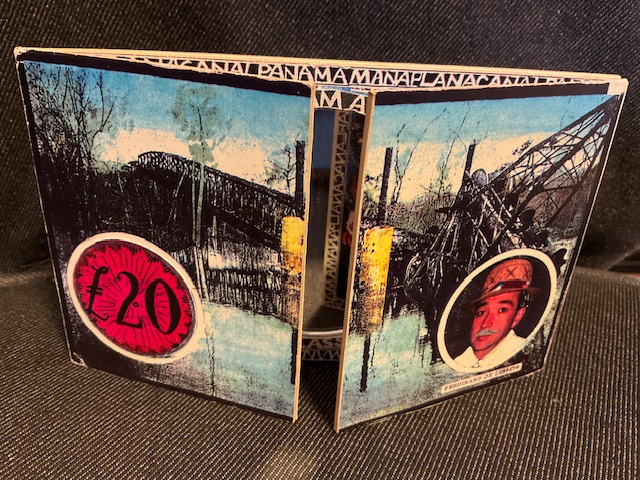
Our next production, A Man A Plan A Canal Panama, was devised to coincide with the only palindromic year of the 20th century, 1991. As Grapple was based on the idea of the song cycle, A Man A Plan A Canal Panama followed the structure of the palindrome. We all got quite obsessive about palindromes
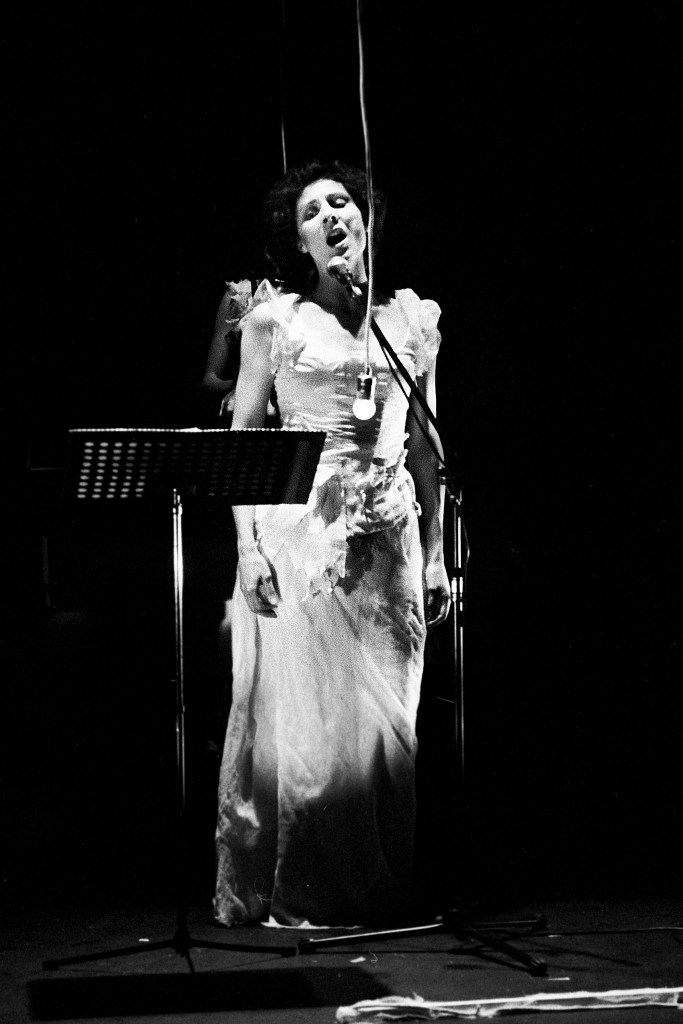
Jocelyn reversed her setting of the yellow fever poem creating a new piece, yellow fever psalm. This was the beginning of Joc’s practise of composing backwards music which led to a whole body of work, a whole new genre really and eventually led to her writing music for Stanley Kubrick’s Eyes Wide Shut. Melanie became famous for backwards singing. So Jocelyn’s forwards and backwards song was the central piece sandwiched by 2 movements by Simon called Subi Dura a Rudibus and my A Man A Plan A Canal Panama part 1 and 2 front and back. Click to listen to Yellow Fever Psalm (link to Bandcamp).
We increased the size of the band adding clarinettist Sarah Homer and violinist and performer Amanda Hadingue and invited actor Trevor Stuart to represent the central figure in the building of the Panama Canal, Ferdinand de Lessups.

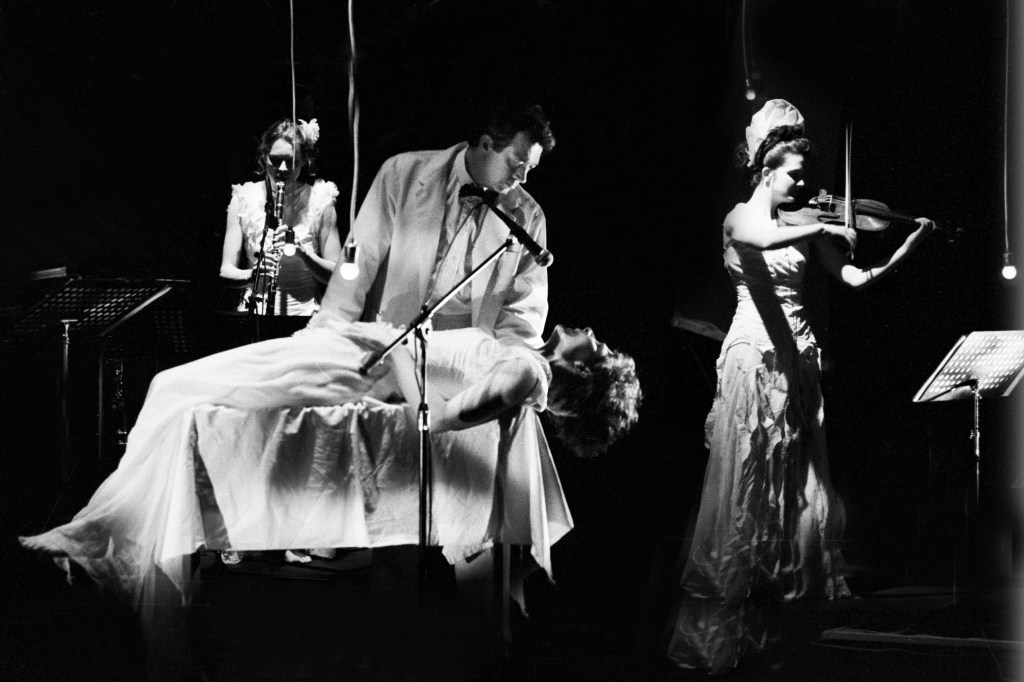
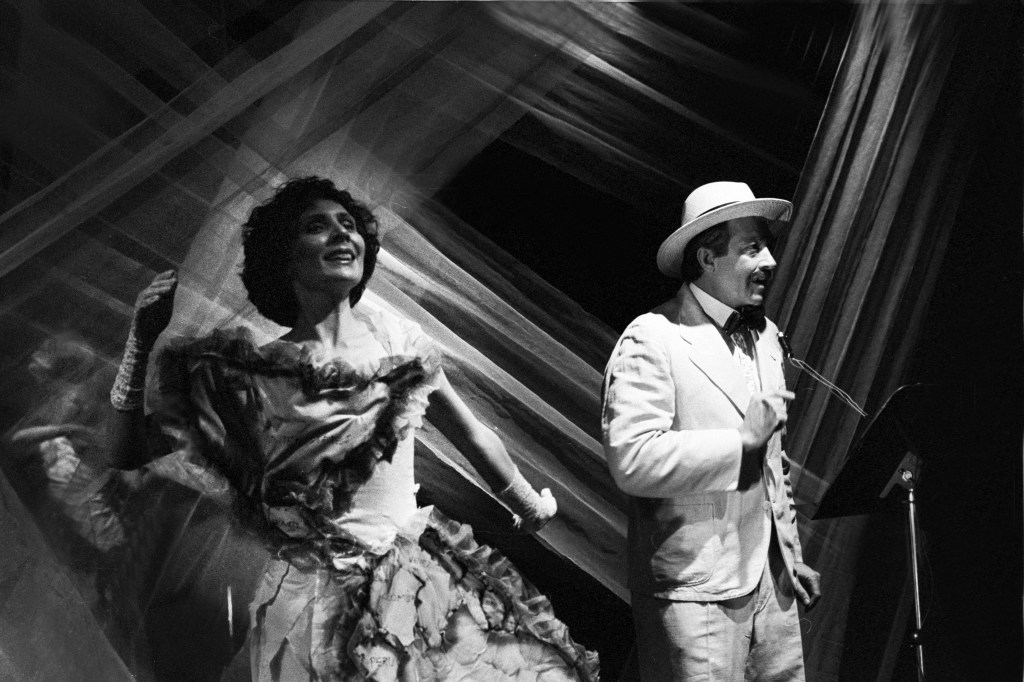
Amanda Hadingue, Jocelyn Pook, Melanie Pappenheim and Trevor Stuart in A Man A Plan A Canal Panama, ICA, 1991
photos © Sheila Burnett
Alan Hay created texts for monologues and song setting and Naomi Matsumoto and Barbara Hook, collaborators from Grapple, provided lighting and costume design. Again we were creating the work for the ICA and so had the theatre’s technical team at our disposal. In addition, Chahine Yavroyan created a pully system by which a Panama hat would come from the back of the auditorium at the beginning to land on Ferdinand de Lessups head and be lifted off and whisked back at the end. As I said, we were palindrome-obsessed.
Melanie and I spent hours and days with scissors and tippex, applying for funding from the Arts Council, on this occassion unsuccessfully. Success with the Arts Council and other funding bodies came later. To raise money in true Panama Canal Company style, Katy McPhee designed some beautiful share certificates to sell. We were given 60% of the box office by the theatre. Even so we must have done it on an absolute shoe string.
For much of 3 or 4 Composers output the context was the experimental theatre and performance art circuit. Whereas our peer ensembles mostly performed in programmes alongside other experimental music groups, 3 or 4 Composers work was to be found in festivals with Forced Entertainment, Bobby Baker or Gary Stevens.
Music was still absolutely the central element. But we were looking for different ways of doing things. In A Man A Plan A Canal Panama, we were playing with the idea of the set as instrument, sound resulting from gesture and action, using extended vocal techniques and structuring the whole as well as the detail using the palindrome. Just as we had tried to find new ways of presenting song cycles in Grapple, here we were experimenting with ways of making music theatre.
THE DUNWICH BELLS TRILOGY

After A Man A Plan A Canal Panama, we started research into the history of Dunwich in Suffolk where the town’s churches and many church bells are submerged in the North Sea following the silting up of the harbour after huge storms in the 13th and 14th centuries. The story goes that at certain times you can hear the bells ringing under the water. This time we managed to secure funding from the Arts Council for research and development. I think this was the first round of New Collaborations grants.
I have found the minutes of the meeting we had in the Autumn of 1992 to decide how to proceed with the R&D. At this meeting Laurence said that he was not interested in theatre work in general and the drowned bells project in particular. But that he would be happy to take on responsibility for concert admin. From that point we created both work with a visual and theatrical dimension and concert work. We produced a promotional cassette including pieces from the projects so far. I’ve discovered that the cassettes are still playable and I’ve started digitizing them – though at present I’m ending up with tiny extracts – like this one of Laurence’s Trio for Roz and Peter.


Melanie, Joc, Simon and I continued with our research into the Dunwich bells. This involved trips to the Suffolk coast and to Whitechapel Bell Foundry from where we hired handbells.


We invited visual artist Deborah Thomas to work with us. We knew her work combining fine art and theatre and thought she would be our ideal partner. We created a trilogy of projects with Deb.
CHERRY RED HEAT

drawing and research
Deborah Thomas
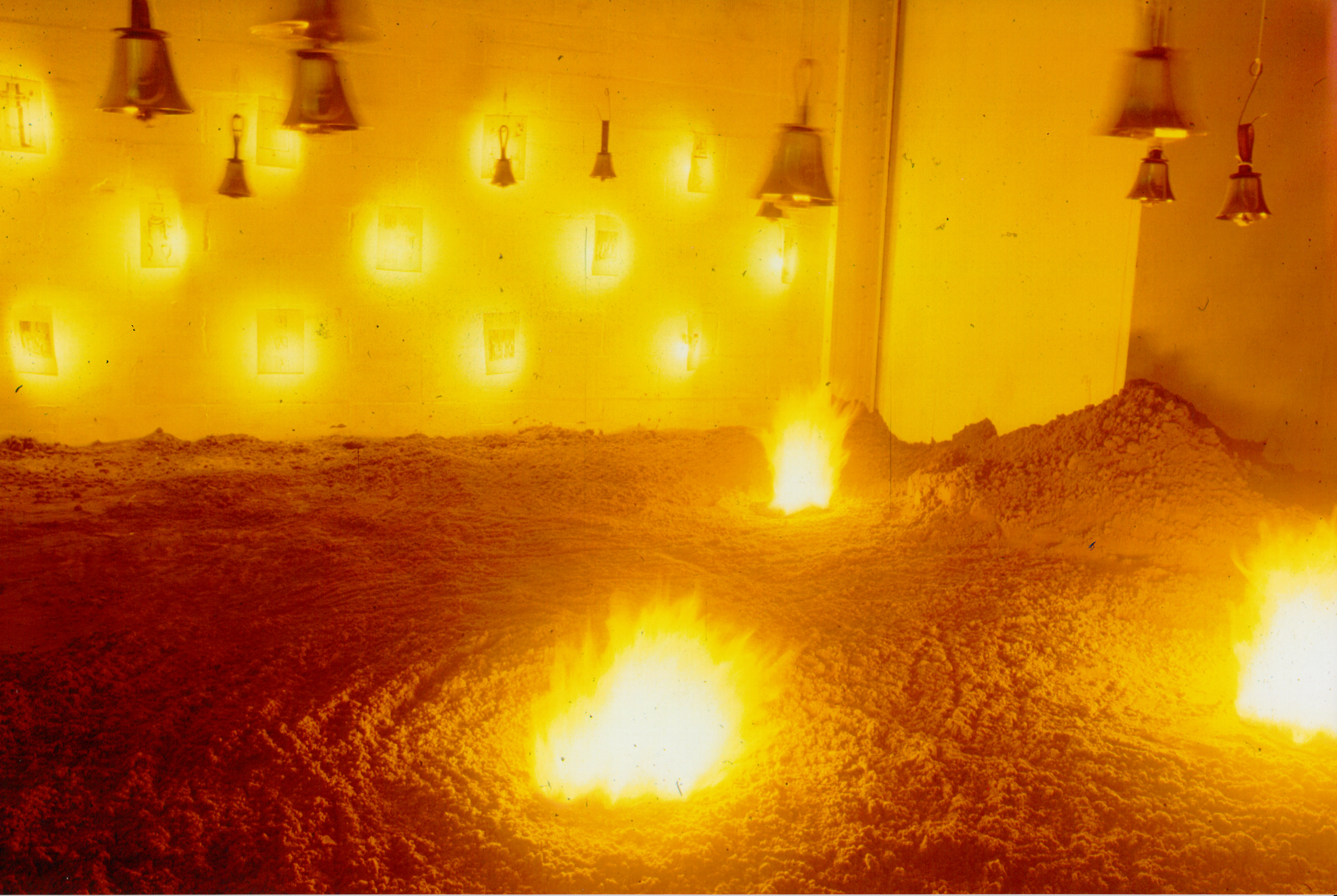
The first part of the trilogy was Cherry Red Heat. This is the name for the temperature molten metal has to reach to cast a bell. It was presented as a work in progress at Deb’s studio in Stratford East in August 1993. Writer Alan Hay described the event:
“Cherry Red Heat consisted of 3 pieces of music: Simon Rackham’s Bel Canto scored for handbells, Awakenings by Jocelyn Pook and Helen Ottaway’s Dedications. In collaboration with sculptor Deborah Thomas, the company have created a space reminiscent of both sea-shore and bell-foundry. Three large bell cores, 5 foot plaster moulds used in the casting of bells, stand towards the rear of the space. The floor is covered in sand; a few small fires burn there. One wall bears small pieces of text taken from inscriptions on church bells, and the opposite wall carries several transparencies from an eccentric work by Robert Fludd which show designs for wind and water powered musical instruments.” (photos by Daniel Faoro)


RING

drawing
Deborah Thomas
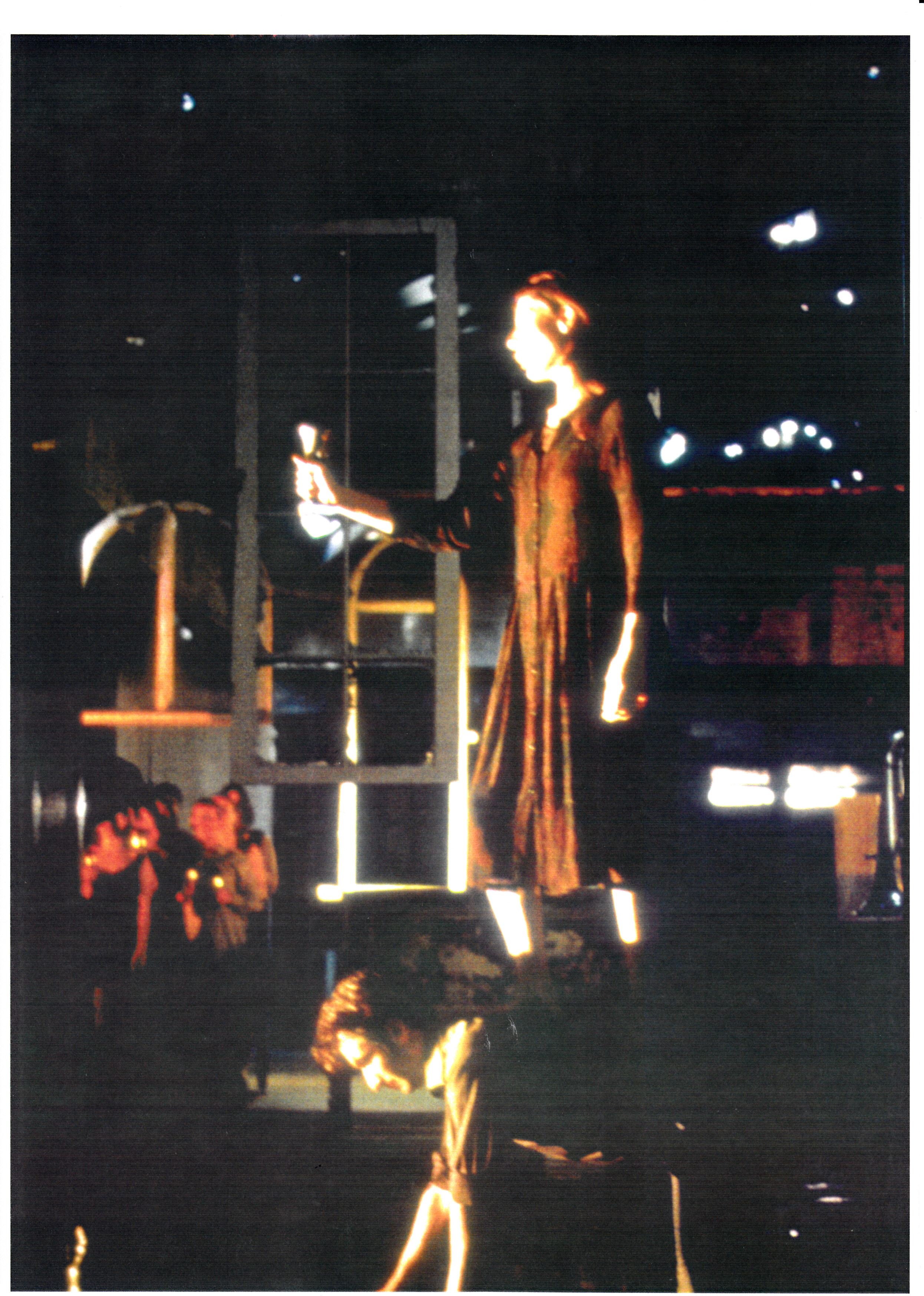
The second part of the trilogy, RING, was a promenade performance in the foyer of the Royal Festival Hall, commissioned for the QUICK festival of Live Art. The programme said: “every so often bell ringers and choristers from the drowned churches of Dunwich rise up from the sea and retell the story of the town’s disappearance. They move through the crowd as if through water, their language and gestures bear remnants of meaning, echoes of past ceremonies…… This was also the occasion of Deb’s first piano dress. A garment designed to dress piano and pianist as one.

STILL RINGING

The final part of the trilogy, Still Ringing, was commissioned for Barclays New Stages regional festival in Nottingham. If the ICA was the hub of experimental theatre and arts in London then the city that excelled at nurturing new performance work outside the capital was Nottingham. This was where we met producer Bill Gee who worked with us to create a magical event in a disused banana warehouse in the centre of the city. Still Ringing was the culmination of all of our Dunwich bell research and work in progress. Like Cherry Red Heat it was an installation animated by music and performance, but on a much larger scale.
Following our interest in Robert Fludd’s eccentric designs for water and wind powered instruments we set out to commission a new instrument. We met, by chance, instrument maker Chris Challen and he agreed to make a wind driven organ inspired by Fludd’s designs. Simon wrote the opening piece which featured the organ – here he is programming it and click on the video link to view the performance.


We recruited a choreographer who Melanie had worked with, Thom Stuart. Rachel Shipp, ex ICA theatre technician took on the role of technical director. As uusual the company were the performers with the addition of Thom in a movement role, Anne Wood on violin and Jeremy Peyton Jones’ music students from Nottingham Trent University. You see how circular this all is – Jeremy providing links again! (photos of Nottingham performance by Fay Cuthbertson)

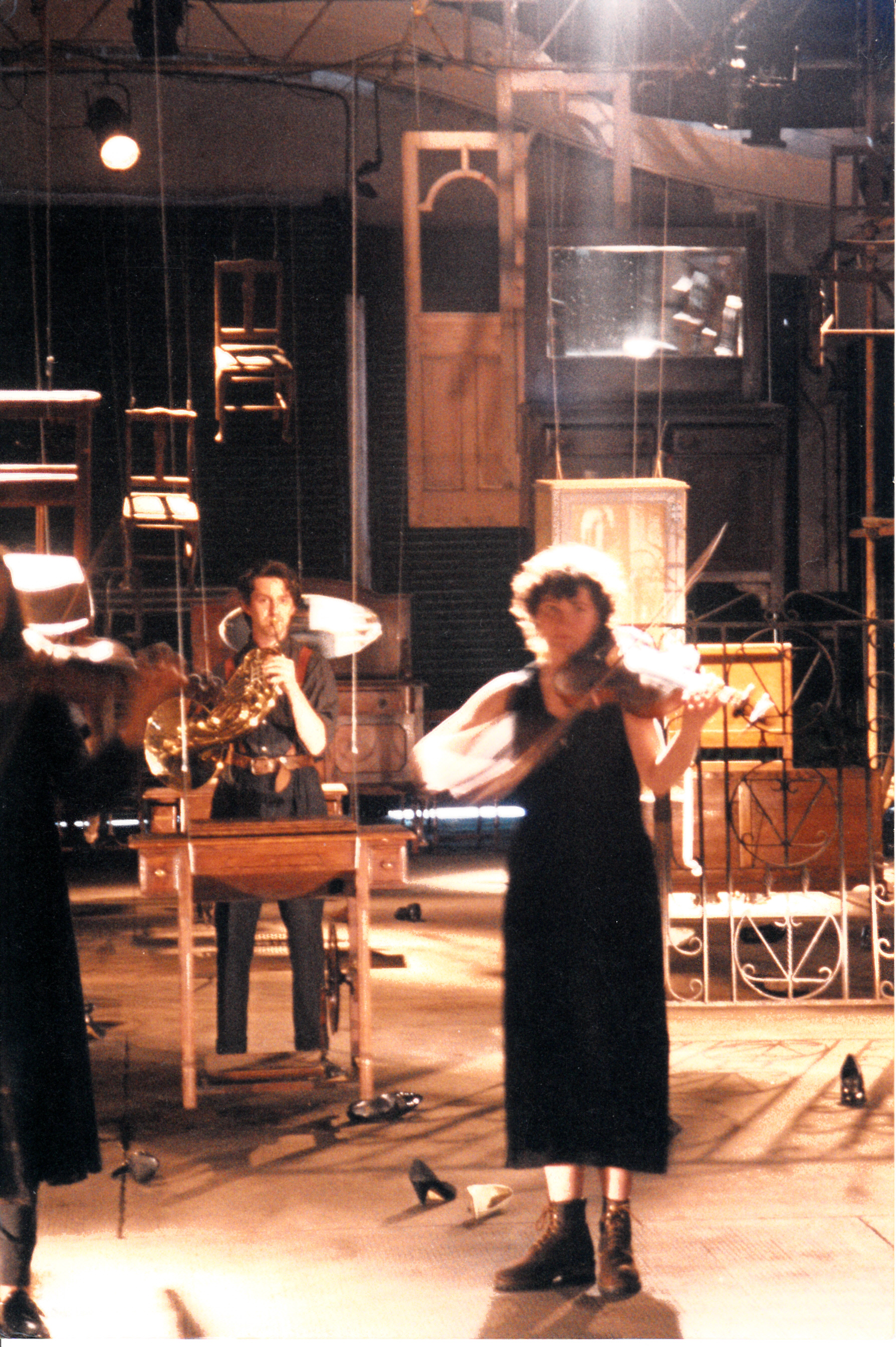


Deborah Thomas created a set of seemingly free-floating furniture hanging by wires from the ceiling, with dripping water and pebbles and abandonned shoes on the floor. Combining music, visuals and movement we wanted to evoke to sense of a place gradually overwhelmed by water. The video of the Nottingham production of Still Ringing can be found on Vimeo, divided into it’s constituent parts: 1. Flood by Simon Rackham (see embedded video above); 2. Falling Slowly by Jocelyn Pook: 3. Bouncing Back by Simon Rackham; 4. Deep Down by Simon Rackham; Weather Report by The Company; 6. Storm Bells by Helen Ottaway and 7. The Other Person has Cleared by Jocelyn Pook. Click on titles to view videos.
As well as the installation versions of Still Ringing in Nottingham and for Arnolfini in Bristol we also presented concert versions in Blythburgh Church in Suffolk and the Bridewell Institute in London. We had other ambitions for the piece – before he died, we were in discussion with writer and Suffolk resident Roger Deakin, about the possibility of presenting a performance on Dunwich beach and creating a film. Years later a plan to recreate Still Ringing on Dunwich beach made it to the Artangel shortlist of 100. But it was not to be and that final iteration is yet to happen. (photos of Bristol production of Still Ringing below by Bridget Mazzey)

Throughout this period 3 or 4 Composers still presented occasional concerts, including Sweep and Mop Furlongs (another of Larry’s enigmatic titles) at Christchurch, Highbury Grove and a performance at Salisbury Festival featuring another of Deb Thomas’s piano dresses for Helen Ottaway’s Red Velvet Piece and a corrugated iron wall for Jocelyn’s music from Blight designed by Laura Hopkins.

In the summer of 1998, with another slightly expanded ensemble, we were back in Nottinghamshire presenting a set of site specific concerts for Nottingham County Council’s Music in Quiet Places series. This was when I received my first ever individual commission – to compose five movements for string quartet – one for each venue of the tour. Here is an extract of the final movement, inspired by the framework knitting museum in the village of Ruddington. Visit my bandcamp page to hear the whole quartet on my two string quartets album as well as my other music.
By this time I had moved to Somerset, all of us were getting busier individually and it was getting harder to find time to pursue 3 or 4 Composers projects as well. A couple more projects were developed by Melanie and Simon – one in Reading and a research project Matter Matter but the Nottingham tour was the last thing we did all together.
More information about 3 or 4 Composers members here:
Laurence Crane
Helen Ottaway and Artmusic
Melanie Pappenheim
Jocelyn Pook
SImon Rackham
I’ve mentioned our main collaborators in my talk but there are loads of other people who worked with us and supported us. Apologies to anyone I’ve forgotten.
Thanks to
Musicians and performers: Sonia Slany; Harvey Brough; Emma Bernard, Amanda Hadingue; Mary Shand; Sarah Homer; Trevor Stuart; Kelly McCusker; Jacquelie Norrie; Sophie Harris, Johnathan Peter Kenny; William Purefoy; Thom Stuart; Anne Wood;
Technicians: Rachel Shipp ; Chahine Yavroyan ; Chris Ekers;
Producers : Lois Keidan; Nikki Milican; Adrian Evans; Stella Hall; Bill Gee; Bridget Mazzey; Kathy Doust; Helen Marriage;
Venues and festivals: ICA London; Acme Studios London, National Review of Live Art Glasgow; Wingfield Arts and Blythburgh Church, Suffolk; various venues in Nottinghamshire; Royal Festival Hall London; Bridewell Institute London;
Photographers: Sheila Burnett for A Man A Plan A Canal Panama: Daniel Faoro for Cherry Red Heat; Steve Ehrlicher for RING: Fay Cuthbertson for Still Ringing.
Finally very many thanks to conference organisers Ian Gardiner and Tom Armstrong and to Imogen Burman for managing the day on behalf of Goldsmiths’ Music Department.
At the end of the conference Melanie Pappenheim and I performed my WInd & Unwind for musical box and voice. (photos courtesy Robin Rimbaud) Wind & Unwind was premiered in 2019 in Sherborne Abbey as part of Dorset Moon, commissioned by the Arts Development Company and produced by Activate Performing Arts and Inside Out Dorset.





 Helen Ottaway