3 or 4 Composers Grapple …

Below is the paper I delivered to the one day conference More Sounds, More Personalities, British PostMinimalism 1979-97‘ at Goldsmiths College, University of London, 18th September 2024.


All but one of the composing and performing group 3 or 4 Composers are taking part in today’s conference.  My title slide is a drawing by the one who isn’t here today – Simon Rackham – who created images for many of our flyers and programmes. 

In early 1989 a group of musicians were drinking coffee in the ICA bar. We were approached by Lois Keidan, then programmer of the ICA theatre.  She wanted to know if we had any thoughts about filling a hole in her schedule coming up that May.  This was the moment that 3 or 4 Composers was born and the event we presented on 30th May 1989 – ‘3 or 4 Composers Grapple with the Notion of English Song’ – was the beginning of 10 years of fruitful collaboration with each other and with other artists.

The group comprised me, Helen Ottaway, (ex Goldsmiths’ music student and founder member of Regular Music with Jeremy Peyton Jones and Andrew Poppy); Jocelyn Pook (ex Guildhall student who had worked with Jeremy Peyton Jones as a musician for Impact Theatre’s A Place in Europe); Melanie Pappenheim (ex King’s student who had worked with Jeremy Peyton Jones on Lumiere & Son Theatre Company’s show Panic); Simon Rackham (painter, composer and French horn player – ex R.A.M. student who played with Melanie in the band Shopping Trolley) and Laurence Crane (ex Nottingham University student, founder and co-director of the minimal music group The Wink).

Lois Keidan went on to help establish ‘The New Collaborations Fund’ in the Combined Arts Department at the Arts Council which she said to the assembled composers and performers ‘will be for people like you’.  That fund has indeed been a huge support for people like us for quite a few decades. 

All of us went on to have individual and distinctive careers in music but I’d like to tell the story of our early experiments together in collaborative and site specific music, installation and music theatre. 

Between 1989 and 1998, 3 or 4 Composers collaborated with visual artists, flower arrangers, theatre makers, instrument makers, fire artists and engineers.  We worked with other musicians, sound designers, technicians and producers to create work for a wide range of venues and sites.   

In the 1980s and 90s there was a constant criss-crossing between disciplines and a rich array of collaborative work involving music, theatre, dance and fine art.  Some of the members of 3 or 4 Composers met through working in experimental theatre.  Singer Melanie and French horn player Simon met while working on a theatre piece at Dartington.  Here they also met Barbara Hook who contributed costumes for 3 or 4 Composers’ early performances.  I met both Jocelyn and Melanie through Jeremy Peyton Jones when he and they were working with Impact Theatre Company and Lumiere and Son.  Jeremy was a link between worlds and between people and eventually both Jocelyn and Melanie were part of Regular Music too.

Melanie and Laurence had met through their respective university friends James Duke and Andrew Renton – around the time that 3 or 4 Composers was formed, Larry wrote pieces about both of these friends: 2 six minute piano pieces James Duke son of John Duke and Andrew Renton becomes an international art critic.  Melanie also introduced Larry and Simon.

My introduction to Simon was through his suite of piano pieces ‘A Small Selection of Cheeses’. The Cheeses had been performed at a concert at the Royal Academy.  When the original pianist wasn’t available for a second performance Melanie suggested Simon ask me to stand in.  So I performed Simon’s ‘Small Selection of Cheeses’ for the first time at Lauderdale house in Highgate at a concert of work by Laurence and Simon promoted by Larry’s Extremely Big Music. And this was also how I met Laurence.  Simon went on to write many other piano works for me and I became as Larry describes ‘ the principal interpreter of Simon’s piano music’.

By 1988 we all knew each other and as I said in early 1989 we were drinking coffee in the ICA bar together. I really can’t overplay the importance of the ICA.  They had a great series called Musica which featured all the new music ensembles.  At the same time the theatre was hosting 3 and 4 week runs of experimental theatre shows. 

The name 3 or 4 Composers came about because although Jocelyn, Laurence and Simon were all already composing and having work performed, I was, at that point, quite a sought after pianist but not a composer.  This was an opportunity for me to compose but there was a touch of uncertainly – hence the name. Melanie was the central performer but she was also an active collaborator with composers she worked with and often could be described as a co-composer.  And she has since worked as a composer.  In a recent conversation with Laurence it seems he thought perhaps he was the or 4 as he bowed out of involvement in the more theatrical and installation-based work we made. 

3 OR 4 COMPOSERS GRAPPLE WITH THE NOTION OF ENGLISH SONG

3 or 4 Composers Grapple with the Notion of English Song, NRLA, Glasgow, 1989

We were interested in new ways of performing. Right from the beginning there was a sense of irony and a theatricality to our performances.  The title for our first concert ‘ 3 or 4 Composers Grapple with the notion of English Song’ was, as reported in the Time Out listing, our attempt to find a direction for this well loved genre in the 1990s. It was also an example of Larry’s tongue in cheek irreverence and his talent for witty and ironic titles. 

That first concert at the ICA, which we also took to the National Review of Live Art in Glasgow, featured an arrangement of 100 roses, costumes, slide projections and theatre lighting.
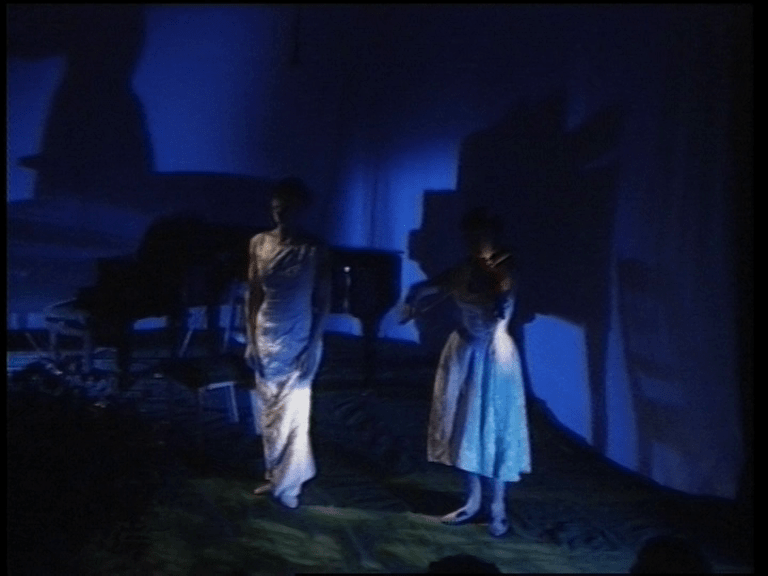
Melanie (voice) and Jocelyn (viola) performing Jocelyn’s A Storm from Paradise

The programme included song cycles by Jocelyn, Simon and Laurence and an instrumental piece, my first composition, Mmm… I Hear Water. 

Something that the National Review of Live Art did very well was to document every performance. The video of 3 or 4 Composers’ performance of Grapple is in the National Review Archives in Bristol University.  So anyone who would like to can see the whole performance.  The stills on the screen are from this video. Click here to view site

Simon Rackham’s A Rose Annual, performed by Helen Ottaway (piano), Robert Woolard (cello), Sarah Harrison (violin) and Melanie Pappenheim (voice)

We were fortunate to be part of a large network of players, but also to have worked with theatre companies like Lumiere and Son and producers like Artsadmin.  This experience allowed us to be  ambitious in terms of scale and context.  Everything we did was dependent on  finding the right people and the right places.  And we were very lucky in both.

A MAN A PLAN A CANAL PANAMA

A Man A Plan A Canal Panama, ICA, photo © Sheila Burnett

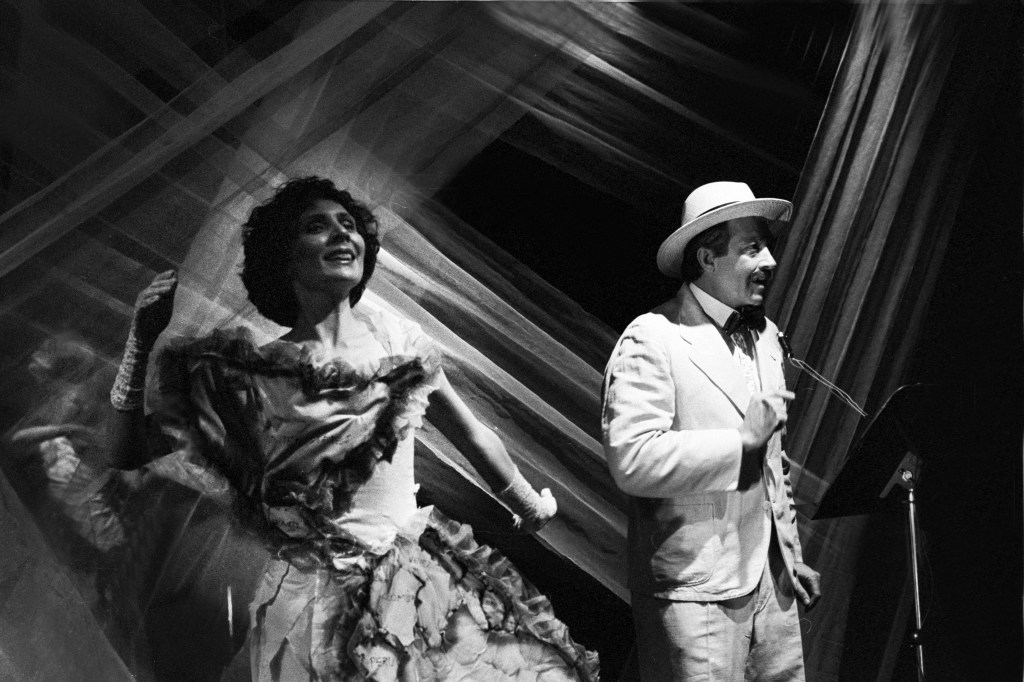
Our next production, A Man A Plan A Canal Panama, was devised to coincide with the only palindromic year of the 20th century, 1991. As Grapple was based on the idea of the song cycle, A Man A Plan A Canal Panama followed the structure of the palindrome. We all got quite obsessive about palindromes
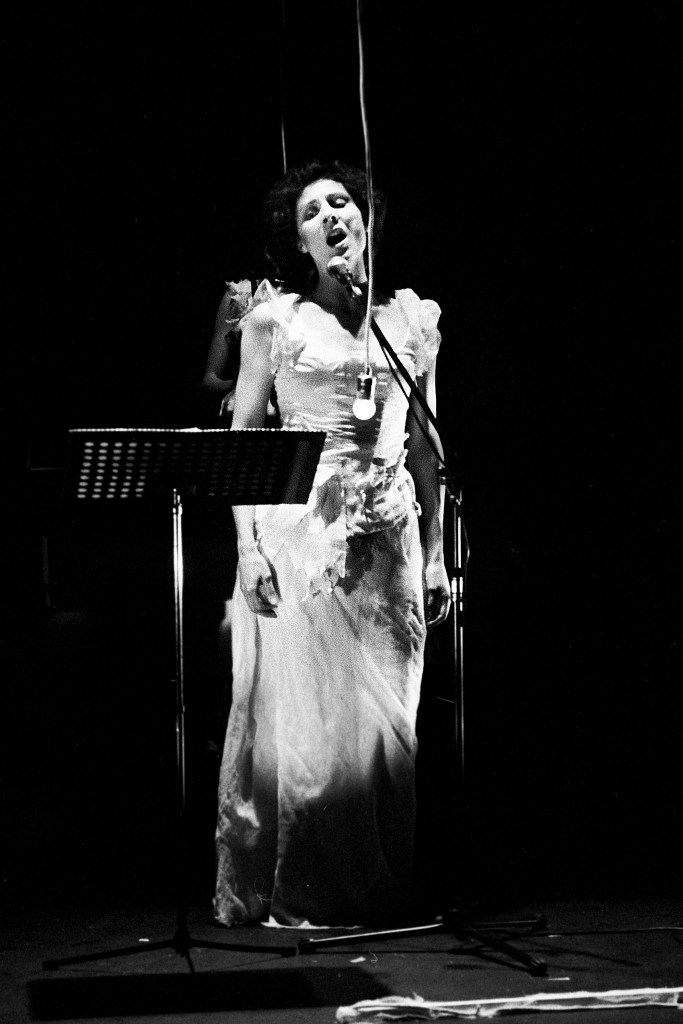
Jocelyn reversed her setting of the yellow fever poem creating a new piece, yellow fever psalm.  This was the beginning of Joc’s practise of composing backwards music which led to a whole body of work, a whole new genre really and eventually led to her writing music for Stanley Kubrick’s Eyes Wide Shut.  Melanie became famous for backwards singing.  So Jocelyn’s forwards and backwards song was the central piece sandwiched by 2 movements by Simon called Subi Dura a Rudibus and my A Man A Plan A Canal Panama part 1 and 2 front and back. Click to listen to Yellow Fever Psalm (link to Bandcamp).

We increased the size of the band adding clarinettist Sarah Homer and violinist and performer Amanda Hadingue and invited actor Trevor Stuart to represent the central figure in the building of the Panama Canal, Ferdinand de Lessups.

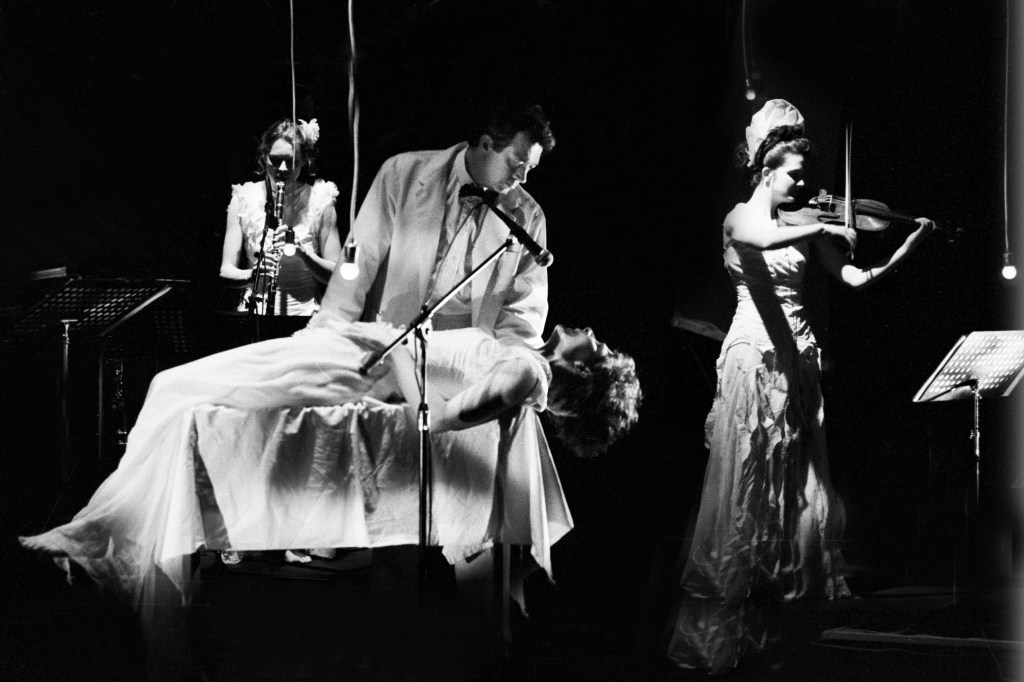
Amanda Hadingue, Jocelyn Pook, Melanie Pappenheim and Trevor Stuart in A Man A Plan A Canal Panama, ICA, 1991


photos © Sheila Burnett


Alan Hay created texts for monologues and song setting and Naomi Matsumoto and Barbara Hook, collaborators from Grapple, provided lighting and costume design.  Again we were creating the work for the ICA and so had the theatre’s technical team at our disposal. In addition, Chahine Yavroyan created a pully system by which a Panama hat would come from the back of the auditorium at the beginning to land on Ferdinand de Lessups head and be lifted off and whisked back at the end.  As I said, we were palindrome-obsessed.


Melanie and I spent hours and days with scissors and tippex, applying for funding from the Arts Council, on this occassion unsuccessfully.  Success with the Arts Council and other funding bodies came later.  To raise money in true Panama Canal Company style, Katy McPhee designed some beautiful share certificates to sell. We were given 60% of the box office by the theatre.  Even so we must have done it on an absolute shoe string. 
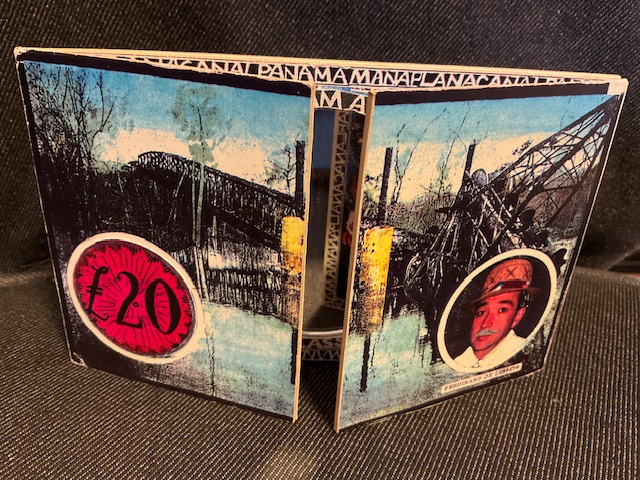

For much of 3 or 4 Composers output the context was the experimental theatre and performance art circuit.  Whereas our peer ensembles mostly performed in programmes alongside other experimental music groups, 3 or 4 Composers work was to be found in festivals with Forced Entertainment, Bobby Baker or Gary Stevens.

Music was still absolutely the central element.  But we were looking for different ways of doing things.  In A Man A Plan A Canal Panama, we were playing with the idea of the set as instrument, sound resulting from gesture and action, using extended vocal techniques and structuring the whole as well as the detail using the palindrome.  Just as we had tried to find new ways of presenting song cycles in Grapple, here we were experimenting with ways of making music theatre.

THE DUNWICH BELLS TRILOGY


After A Man A Plan A Canal Panama, we started research into the history of Dunwich in Suffolk where the town’s churches and many church bells are submerged in the North Sea following the silting up of the harbour after huge storms in the 13th and 14th centuries.  The story goes that at certain times you can hear the bells ringing under the water.  This time we managed to secure funding from the Arts Council for research and development. I think this was the first round of New Collaborations grants.

I have found the minutes of the meeting we had in the Autumn of 1992 to decide how to proceed with the R&D. At this meeting Laurence said that he was not interested in theatre work in general and the drowned bells project in particular.  But that he would be happy to take on responsibility for concert admin.  From that point we created both work with a visual and theatrical dimension and concert work.  We produced a promotional cassette including pieces from the projects so far.  I’ve discovered that the cassettes are still playable and I’ve started digitizing them – though at present I’m ending up with tiny extracts – like this one of Laurence’s Trio for Roz and Peter. 

3D map of Dunwich showing the part which fell into the sea (Dunwich Museum) and below, images from a local newspaper showing destruction to houses in Lowestoft in the 1953 floods


Melanie, Joc, Simon and I continued with our research into the Dunwich bells.  This involved trips to the Suffolk coast and to Whitechapel Bell Foundry from where we hired handbells.


We invited visual artist Deborah Thomas to work with us.  We knew her work combining fine art and theatre and thought she would be our ideal partner.  We created a trilogy of projects with Deb.

CHERRY RED HEAT

drawing and research

Deborah Thomas


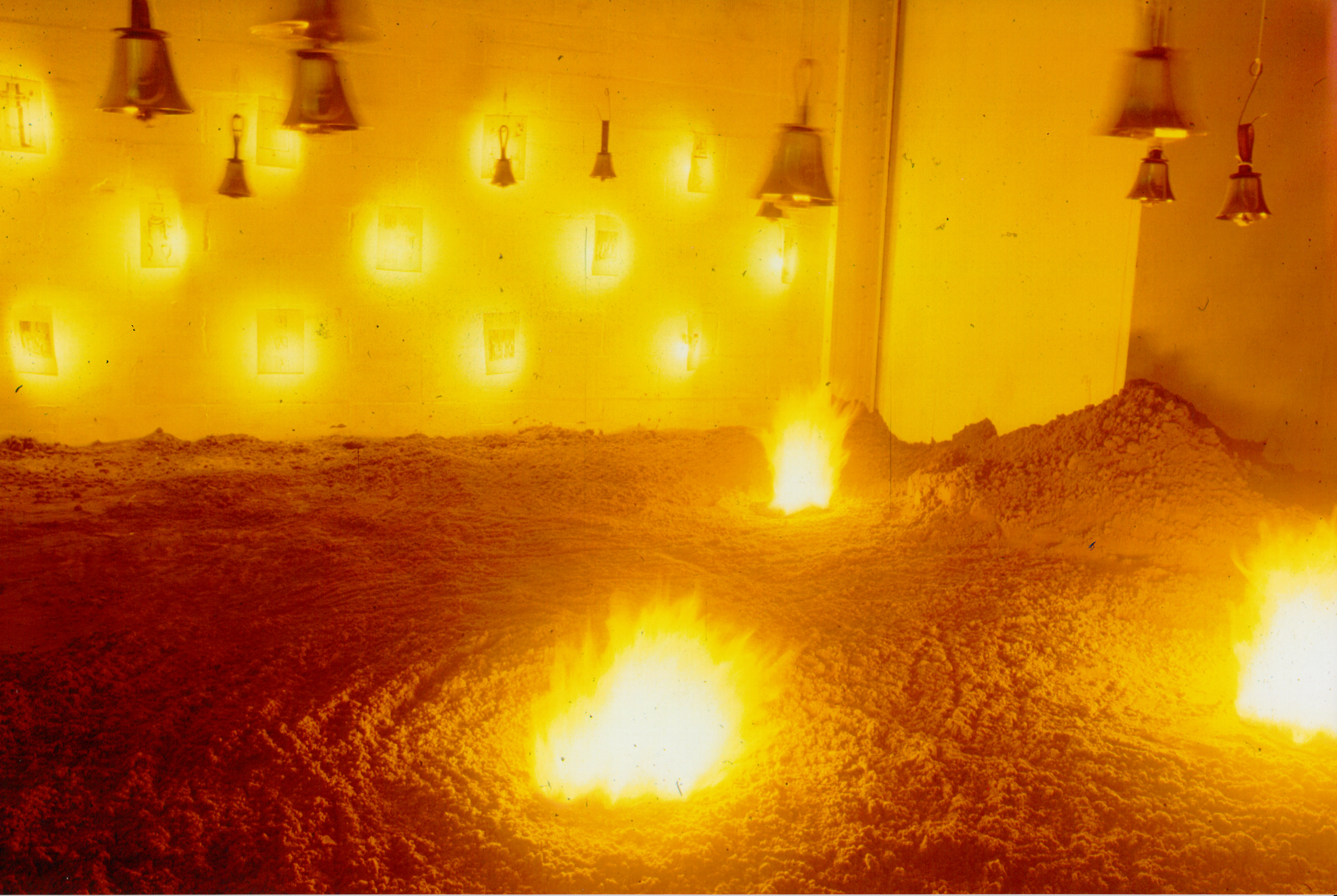
The first part of the trilogy was Cherry Red Heat. This is the name for the temperature molten metal has to reach to cast a bell. It was presented as a work in progress at Deb’s studio in Stratford East in August 1993.  Writer Alan Hay described the event:

“Cherry Red Heat consisted of 3 pieces of music: Simon Rackham’s Bel Canto scored for handbells, Awakenings by Jocelyn Pook and Helen Ottaway’s Dedications. In collaboration with sculptor Deborah Thomas, the company have created a space reminiscent of both sea-shore and bell-foundry.  Three large bell cores, 5 foot plaster moulds used in the casting of bells, stand towards the rear of the space.  The floor is covered in sand; a few small fires burn there.  One wall bears small pieces of text taken from inscriptions on church bells, and the opposite wall carries several transparencies from an eccentric work by Robert Fludd which show designs for wind and water powered musical instruments.” (photos by Daniel Faoro)

RING

drawing
Deborah Thomas

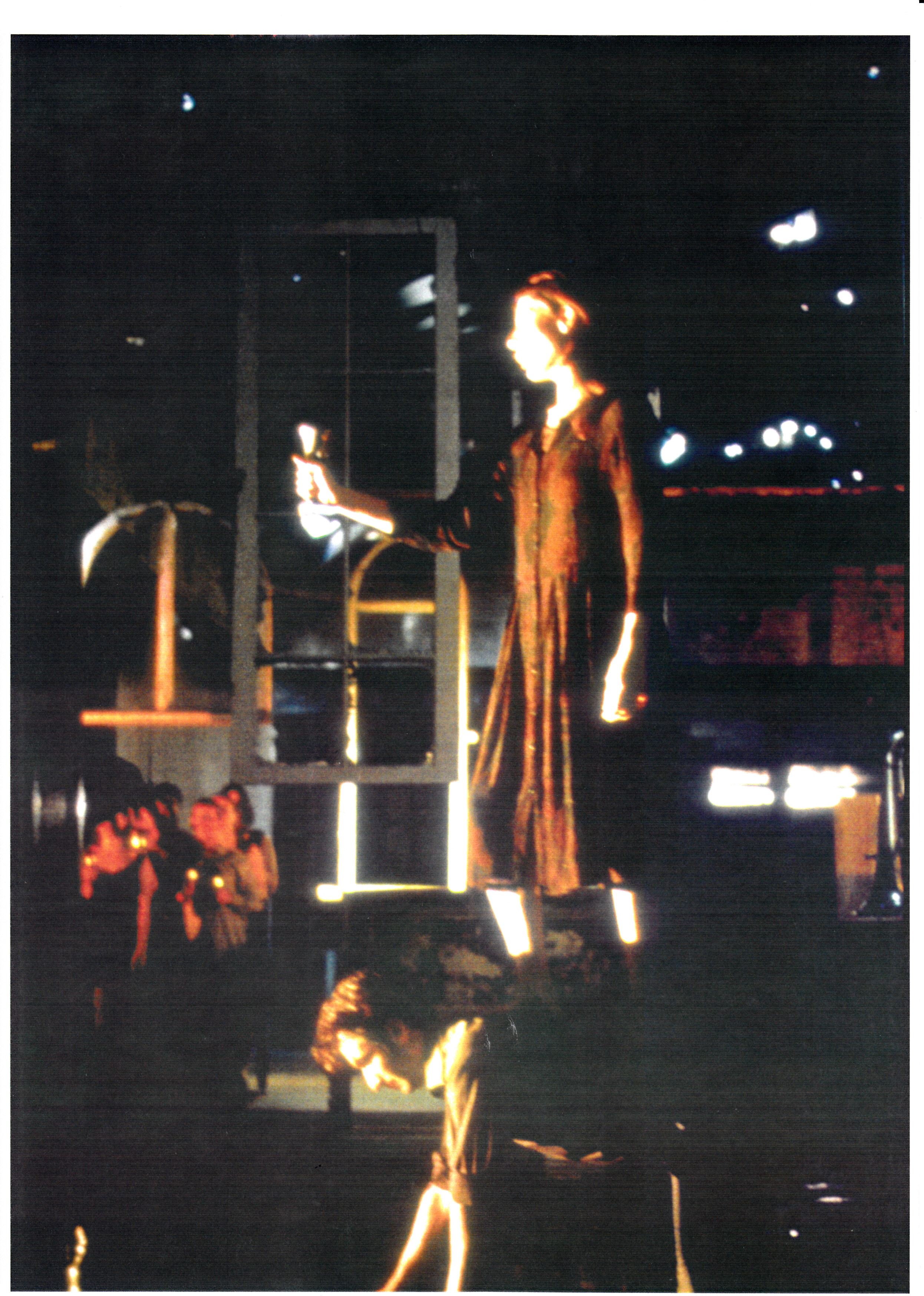
The second part of the trilogy, RING, was a promenade performance in the foyer of the Royal Festival Hall, commissioned for the QUICK festival of Live Art.  The programme said: “every so often bell ringers and choristers from the drowned churches of Dunwich rise up from the sea and retell the story of the town’s disappearance.  They move through the crowd as if through water, their language and gestures bear remnants of meaning, echoes of past ceremonies……  This was also the occasion of Deb’s first piano dress.  A garment designed to dress piano and pianist as one. 

RING, performed at RFH foyer (photo Steve Ehrlicher)

STILL RINGING

publicity image, Deborah Thomas

The final part of the trilogy, Still Ringing, was commissioned for Barclays New Stages regional festival in Nottingham.  If the ICA was the hub of experimental theatre and arts in London then the city that excelled at nurturing new performance work outside the capital was Nottingham.  This was where we met producer Bill Gee who worked with us to create a magical event in a disused banana warehouse in the centre of the city.  Still Ringing was the culmination of all of our Dunwich bell research and work in progress.  Like Cherry Red Heat it was an installation animated by music and performance, but on a much larger scale. 

Following our interest in Robert Fludd’s eccentric designs for water and wind powered instruments we set out to commission a new instrument.  We met, by chance, instrument maker Chris Challen and he agreed to make a wind driven organ inspired by Fludd’s designs.  Simon wrote the opening piece which featured the organ – here he is programming it and click on the video link to view the performance.


We recruited a choreographer who Melanie had worked with, Thom Stuart. Rachel Shipp, ex ICA theatre technician took on the role of technical director.  As uusual the company were the performers with the addition of Thom in a movement role, Anne Wood on violin and Jeremy Peyton Jones’ music students from Nottingham Trent University.  You see how circular this all is – Jeremy providing links again! (photos of Nottingham performance by Fay Cuthbertson)

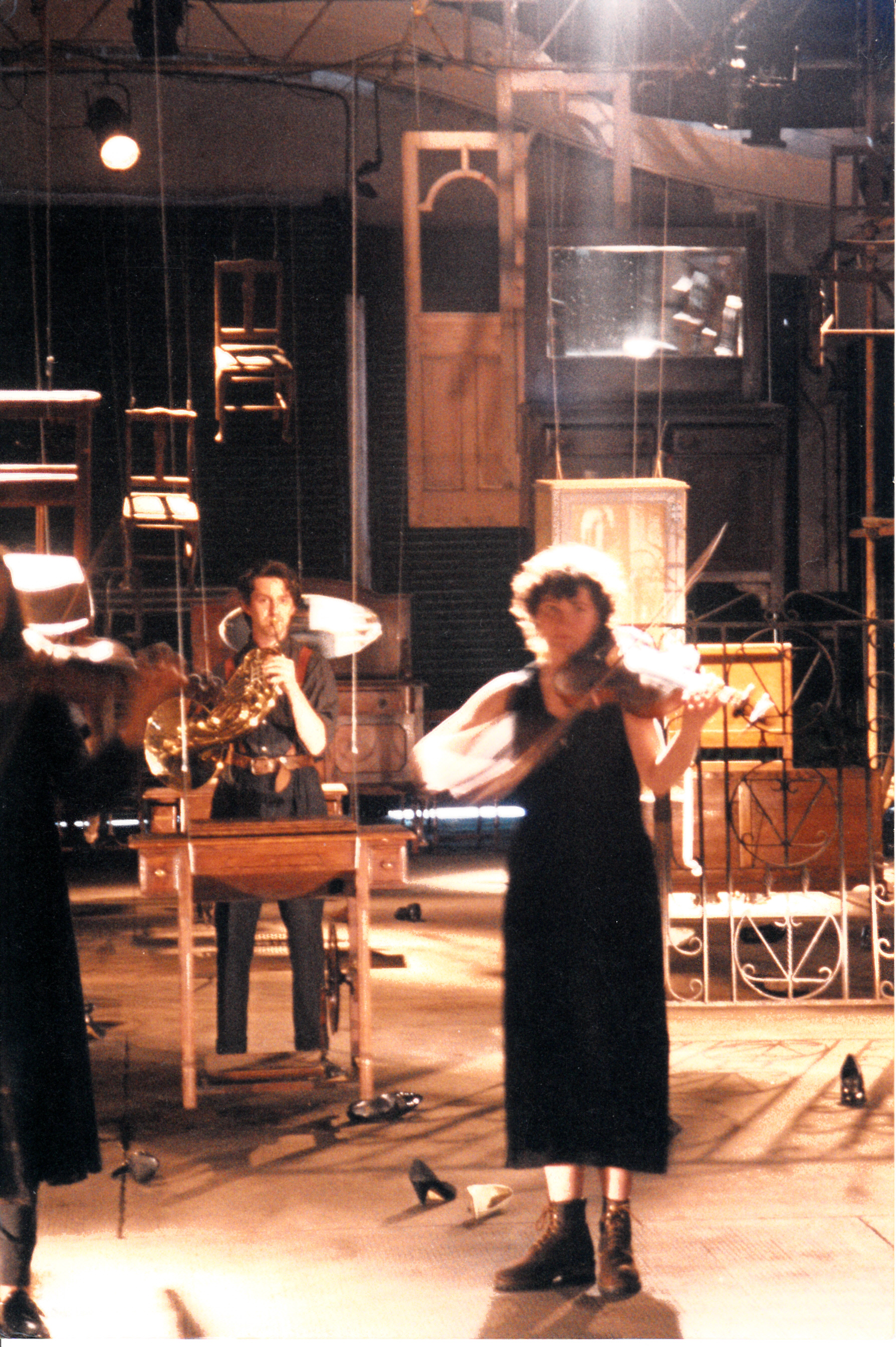
Deborah Thomas created a set of seemingly free-floating furniture hanging by wires from the ceiling, with dripping water and pebbles and abandonned shoes on the floor.  Combining music, visuals and movement we wanted to evoke to sense of a place gradually overwhelmed by water.  The video of the Nottingham production of Still Ringing can be found on Vimeo, divided into it’s constituent parts: 1. Flood by Simon Rackham (see embedded video above); 2. Falling Slowly by Jocelyn Pook: 3. Bouncing Back by Simon Rackham; 4. Deep Down by Simon Rackham; Weather Report by The Company; 6. Storm Bells by Helen Ottaway and 7. The Other Person has Cleared by Jocelyn Pook. Click on titles to view videos.

As well as the installation versions of Still Ringing in Nottingham and for Arnolfini in Bristol we also presented concert versions in Blythburgh Church in Suffolk and the Bridewell Institute in London.  We had other ambitions for the piece – before he died, we were in discussion with writer and Suffolk resident  Roger Deakin, about the possibility of presenting a performance on Dunwich beach and creating a film.  Years later a plan to recreate Still Ringing on Dunwich beach made it to the Artangel shortlist of 100. But it was not to be and that final iteration is yet to happen. (photos of Bristol production of Still Ringing below by Bridget Mazzey)


Throughout this period 3 or 4 Composers still presented occasional concerts, including Sweep and Mop Furlongs (another of Larry’s enigmatic titles) at Christchurch, Highbury Grove and a performance at Salisbury Festival featuring another of Deb Thomas’s piano dresses for Helen Ottaway’s Red Velvet Piece and a corrugated iron wall for Jocelyn’s music from Blight designed by Laura Hopkins. 


In the summer of 1998, with another slightly expanded ensemble, we were back in Nottinghamshire presenting a set of site specific concerts for Nottingham County Council’s Music in Quiet Places series.  This was when I received my first ever individual commission – to compose five movements for string quartet – one for each venue of the tour.  Here is an extract of the final movement, inspired by the framework knitting museum in the village of Ruddington. Visit my bandcamp page to hear the whole quartet on my two string quartets album as well as my other music.

By this time I had moved to Somerset, all of us were getting busier individually and it was getting harder to find time to pursue 3 or 4 Composers projects as well.  A couple more projects were developed by Melanie and Simon – one in Reading and a research project Matter Matter but the Nottingham tour was the last thing we did all together.


More information about 3 or 4 Composers members here:
Laurence Crane
Helen Ottaway and Artmusic
Melanie Pappenheim
Jocelyn Pook
SImon Rackham

I’ve mentioned our main collaborators in my talk but there are loads of other people who worked with us and supported us.  Apologies to anyone I’ve forgotten. 

Thanks to

Musicians and performers: Sonia Slany; Harvey Brough; Emma Bernard, Amanda Hadingue; Mary Shand; Sarah Homer; Trevor Stuart; Kelly McCusker; Jacquelie Norrie; Sophie Harris, Johnathan Peter Kenny; William Purefoy; Thom Stuart; Anne Wood;

Technicians: Rachel Shipp ; Chahine Yavroyan ; Chris Ekers;

Producers : Lois Keidan; Nikki Milican; Adrian Evans; Stella Hall; Bill Gee; Bridget Mazzey; Kathy Doust; Helen Marriage;

Venues and festivals: ICA London; Acme Studios London, National Review of Live Art Glasgow; Wingfield Arts and  Blythburgh Church, Suffolk; various venues in Nottinghamshire; Royal Festival Hall London; Bridewell Institute London;

Photographers: Sheila Burnett for A Man A Plan A Canal Panama: Daniel Faoro for Cherry Red Heat; Steve Ehrlicher for RING: Fay Cuthbertson for Still Ringing.

Finally very many thanks to conference organisers Ian Gardiner and Tom Armstrong and to Imogen Burman for managing the day on behalf of Goldsmiths’ Music Department.


At the end of the conference Melanie Pappenheim and I performed my WInd & Unwind for musical box and voice. (photos courtesy Robin Rimbaud) Wind & Unwind was premiered in 2019 in Sherborne Abbey as part of Dorset Moon, commissioned by the Arts Development Company and produced by Activate Performing Arts and Inside Out Dorset.

The last year and more

It’s been 18 months since I wrote on this blog. Its been a very busy and productive period and I’m still in the middle of it. But time to stop briefly, take a breath and look around.

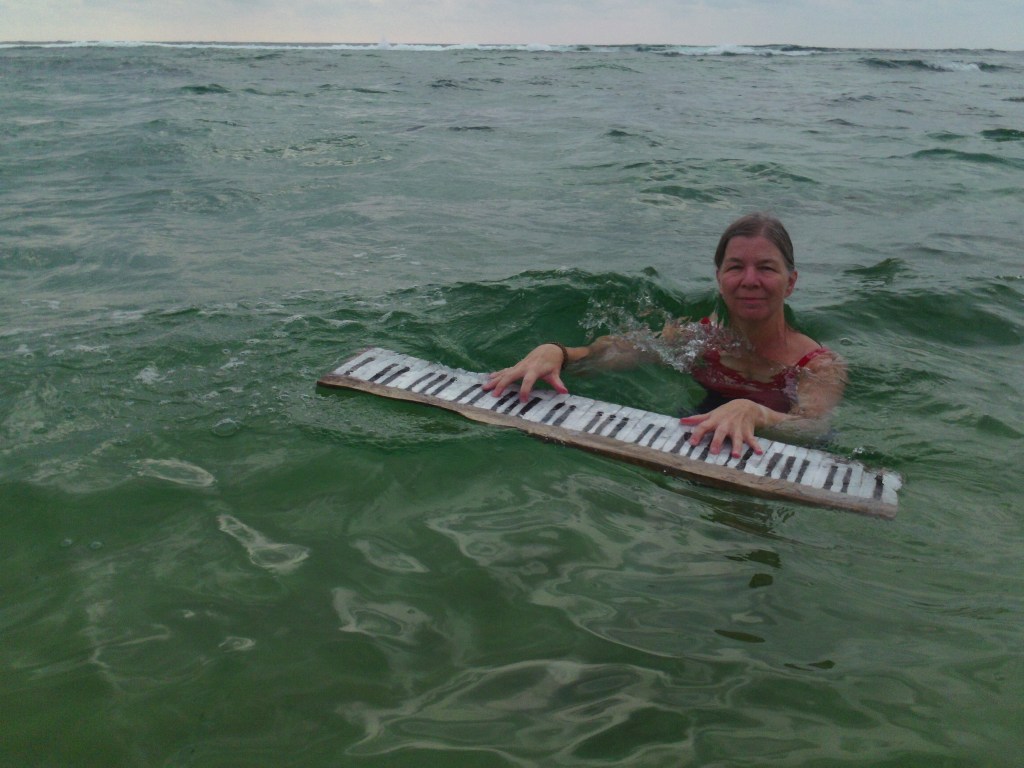
Helen in the Indian Ocean with a driftwood keyboard made by Lorna Rees

Six years ago I was about to embark on a trip to Sri Lanka to take part in the Sura Medura artists residency. While there I started sketching ideas for a requiem, prompted by the death of my mother earlier in the year. I was sponsored by Activate Performing Arts who have continued to support my work towards the requiem. This year the work comes to fruition at Activate’s festival Inside Out Dorset.
Saeflod, a walking requiem has become about more than the loss of one person or even many people in my life. We are suffering environmental losses as well. We live on an island, we see cliff falls and coastal erosion and, in Sri Lanka, I was in a place that was very badly affected by the Indian Ocean Tsunami. The photos taken by Lorna Rees (see above) of me in the ocean, with a driftwood keyboard she had made, illustrate my feeling at the time and often since, of being ‘all at sea’.

I have been working with poet Rosie Jackson for over a year now. The word seaflood, Saeflod in old English, was arrived at together. Rosie has been writing and collecting text and stories and combining words and syllables to create new words and phrases. This echoes the way that Alastair Goolden and I have often created installations – mixing and arranging composed and found material to create ever new combinations and meanings.

Saeflod is a ‘walking requiem’. Artmusic’s work has increasingly been created for and presented outdoors as music and image for the environment. The work will be installed in Moors Valley Country Park (Forestry England) as one of a series of thought provoking and enchanting installations. There will be opportunities to interact with the work and occassional choir performances.

For anyone who hasn’t experienced Artmusic’s oldest installation, Lachrymae, this will also be installed in the woods.

Collaborators include singer Melanie Pappenheim and sound designer Alastair Goolden who I have worked with over many years. I’ve admired Rosie Jackson’s poetry, but this is the first time we’ve worked together. Activate and Inside Out Dorset have close ties with the Arts University Bournemouth. We are lucky to have Anya Hobson and Maise Perkins, with other student helpers, working on the design elements of the piece.

The idea of the requiem has always been to create a work that can be reimagined and adapted for many different venues and spaces. The presentation of the work at Inside Out Dorset is a first step – a work in progress – a toe in the water. Members of the Orchestra for the Earth will be recorded for the installation this year. I look forward to future iterations of the requiem where they may perform live.

I am eternally grateful to Activate Performing Arts for their support. As well as commissioning the work they have been beside me through all the stages of development. I am also thrilled to have received a grant from the PRS Foundation’s Open Fund.

Levantina

The world premiere of my new piano piece ‘Levantina’ is coming up in just over a week. I’m excited by the prospect of seeing and hearing someone else playing a piano piece of mine as this is a first.

A while ago the young Jordanian Palestinian pianist Iyad Sughayer suggested to my sister Frances, with whom he was lodging, that I might write a new piece for him. He had enjoyed playing through my ‘Suite of Somerset Apples’ written for harpsichord. So it was Frances who made the commission on Iyad’s behalf.

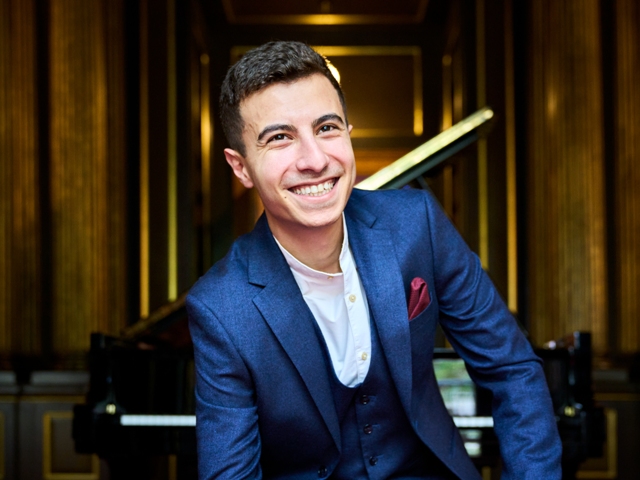
Iyad Sughayer (photo ©Kaupo Kikkas)

Given my interest in folk music and the informal description of me as a ‘folk-minimalist’ we decided that the new piece would be inspired by a folk song from the Levant – hence the title Levantina. In my research I discovered that Levantina is the name of a multinational natural stone company originating in Spain and also a genus of air-breathing land snails. It still seemed the perfect name for a little piece inspired by the Levant so it stuck.

Levantina is based on a folk song which is known by various names but that I know as The Lovers Hymn. The story Iyad tells me, and which I want to hear more about, is that this is a chant sung by women who want to get messages to their husbands and lovers who are away at war. The messages are in code and carried on the wind. This idea of melodies hidden in and carried on the wind has very much inspired the way the piece works with the main tune gradually emerging from inside the texture.

It’s a strange experience having written piano music for myself to perform for over 40 years to think about the experience from another pianist’s perspective. One of my piano pupils is currently learning a piece from my Round & Round set and I’m finding myself explaining how and why the music is the way it is. Like with all kinds of retrospection you find illumination by looking back. There’s a thread common to both pieces of melodies emerging out of patterns.

Iyad plays music from across geographical and temporal boundaries, He performs massive dramatic works with great confidence and panache but can also bring sweetness and delicacy when required. He’s particularly drawn to the music of the Armenian composer Khachaturian, having released his first CD of the composer’s work on the BIS label in November 2019. His second Khachaturian CD recorded with the BBC National Orchestra of Wales is in the pipeline also on BIS.

Iyad’s concert is at 4.00 pm on 6th February at St George’s Bristol. Alongside Levantina he will be playing: Haydn Piano Sonata in F Major Hob XVI:23; Sibelius 6 Impromptus Op 5 and Khachaturian Masquerade Suite, which also appears on the forthcoming album.

The concert is being given in support of PalMusic, an organisation dedicated to improving the lives of young Palestinians through music.

Sitting in the Staircase

We are nearly half way through the presentation of Secret Staircase in vertical spaces in Frome as part of Frome Festival 2021. It has been wonderful sitting at the bottom of these staircases and talking to people about sound and space and memory. It seems to be the case that the installation evokes memories: memories of staircases and events on stairs but also more generally events in life – ups and downs, feelings and moods, somehow the music unlocks feelings as well as memories as well as just existing in the present and in the building or environment it is placed.

Most of the staircases are indoor, parts of the inner workings of buildings, but a couple are outdoors – a chance to hear the sound installation in the open air. All of the sites seem to take people back to events that have happened in the past, on staircases or not; in the imagination or in literature or art. The mind is an incredible thing – making connections, remembering and inventing narratives – making sense of life and art.

It has been lovely to work with saxophonist Nick Sorensen – this is really just the start of what I hope will be an ongoing project. The next stage will involve animation by David Daniels adding another dimension to the work. We are already talking to other venues and many visitors have suggested we make a CD of the music. So watch this space for more manifestitations of Secret Staircase…….

Meanwhile we still have five days of the Frome Festival and Secret Staircase popping up in four very different locations during that time. Follow the links below to book your free tickets for the remaining slots – join us on some of Frome’s staircases.


Location 2: 3rd – 11th July a four storey wooden staircase in an old industrial building
Location 3: 3rd and 6th – 10th July our shortest staircase in a building with many facets
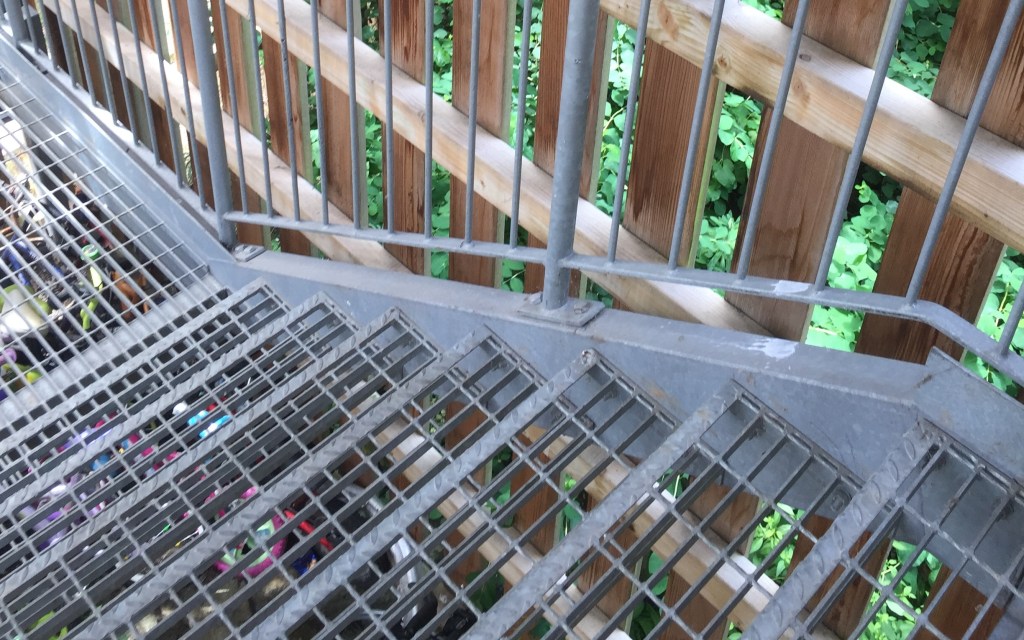
Location 4: 3rd – 7th and 10th July a metal staircase, an escape route, a way out
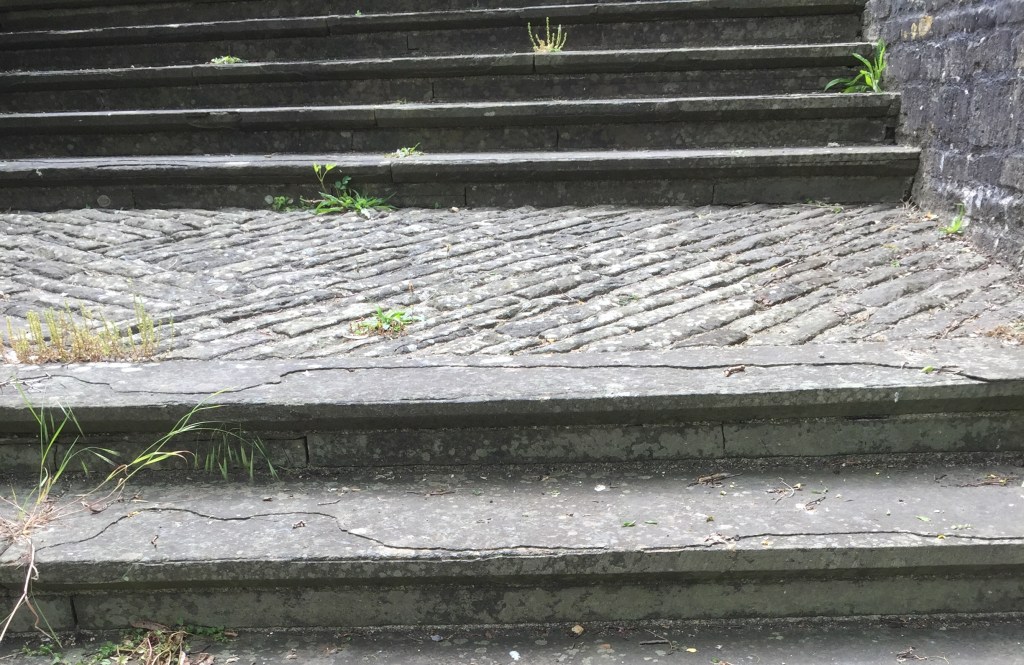
Location 5: 8th, 9th and 11th July stone steps in a sacred setting

Secret Staircase

It’s been a long wait but performance is back, festivals are up and running and we have a new sound installation about to go live in Frome.

Free tickets

Book a free ticket for a 15 minute slot at one or more of 5 locations – all within easy reach of the centre of Frome. Visit www.artmusic.org.uk for details and links for bookings.

The new work is inspired by the Nelson Staircase in Somerset House, London and other beautiful, dramatic and quirky staircases around the world. Come and experience sound moving up and down, rising and falling and floating in vertical spaces.

Composed by Helen Ottaway; performed by Nick Sorensen; visuals by David Daniels; recording by Alastair Goolden; staircase research and marketing by Steve Ehrlicher.

Secret Staircase is part of Frome Festival 2021

Frome Festival is 20 years old this year. Artmusic presented Lachrymae in the Round Tower Gallery of Black Swan Arts for the first Frome Festival in 2001. We have been intermittently involved in the intervening years and are thriiled to be premiering a new sound installation, Secret Staircase, in this anniversary year.

And if you can’t join us this time…

I realise that not all readers live near Frome. I’ll be working with animator David Daniels on an audio visual version of the piece and this will be available to view online later in the year. We’re also looking for festivals and venues to book the installation. It’s going to be such an easy work to tour, I really hope we get the opportunity to take it to other places. Watch this space…..

The Path is Made by Walking

the path to chapel coppice, Ashley Chase, near Abbotsbury, Dorset

Artmusic’s Lachrymae was created by Alastair Goolden (sound designer), Rowena Pearce and Tim Millar (artists) and me (composer) and was installed in Chapel Coppice in Ashley Chase near Abbotsbury for Ridgeway Responses, a walking strand of the Inside Out Dorset festival in 2014.

In 2015 Alastair Goolden and I collaborated with Satsymph to create a geo-located version of this work, resulting in a perpetual ghost of Lachrymae residing in the woods to this day. You can visit the virtual version of Lachrymae by downloading Satsymph’s Land Bone and Stone App no.1 here and following the map to Chapel Coppice with your smart phone. N.B. At present LBS1 is only available for Google Android.

Around this time, and because of this introduction into geo-located sound walking. I became aware of The Museum of Walking and Sound Walk Sunday. Lachrymae and many of Satsymph’s other geo-located sound walks were included in the Sound Walk Sunday directory – an amazing collection of sound walks from all over the world.

Last year I was invited by Black Swan Arts in Frome to curate LISTEN, a summer season of sound art. Along with presenting music and art in different combinations and settings I wanted to work with Satsymph again and also to involve The Museum of Walking in LISTEN. We invited Satsymph to create a new local geo-located sound walk based on the aural histories recorded by Home in Frome in their Working Memories project. This new walk entitled ‘Walking Memories’ explores the centre of Frome through the voices and memories of those who worked in the town in years gone by. You can find the map and a link to the bespoke app on satsymph’s website here. This app is available for both Google Android and iPhone.

The final day of LISTEN coincided with Sound Walk Sunday and we invited co-founders Geert Vermeire and Andrew Stuck to join us for a one day symposium on sound walking. So for 2019 Sound Walk Sunday came to Frome.

I have continued to be associated with the Museum of Walking – now renamed walk – listen – create and as I type we are in the middle of the new month-long festival, Sound Walk September. As always the website lists sound walks that you can experience actually or virtually from all over the world and this year there are a host of other initiatives and activities available too.

One of this year’s projects is 30 Days of Walking, an opportunity for anyone to select a day and time and record their own soundwalk. 25 days of walking have passed so far with over 60 individual walks recorded and uploaded. There are 5 days left so why not record a walk of your own. I recorded my walk on 7th September in Glastonbury. In my Redstone diary for 2020 opposite the first complete week of September is a poem by Antonio Machado, Canto XXIV from Proverbs and Songs 29. The last line of the extract reads ‘The path is made by walking’. I decided to take this poem about walking as my starting point and wander where the poetry led me. I chose Glastonbury as that may have been where I started life. You can listen to my short autobigraphical soundwalk here.

It’s impossible to know where life will take you next. During lockdown I have had new encounters with Literature, and walking which has led me to think more about these two in combination. Poems about walking, thoughts and stories experienced while walking……..definitely fertile ground for new work.

At the invitation of walk – listen – create, on Monday 28th September at 7.00 pm, I will be co-hosting a discussion about the role of movement in the participation in and appreciation of art. I will describe my creative career in terms of movement from performing Music Walk with John Cage in the 1980s and creating animated installation art with 3 or 4 Composers in the 1990s to making movement-generated work and processional performances in the 2000s and discovering nature and new ideas through walking and networking with Inside Out Dorset in the 2010s. Everyone is welcome to join in the discusion – more info and tickets here.

White Storks online

This week’s breaking news is that my new piece White Storks for string octet is now available online.

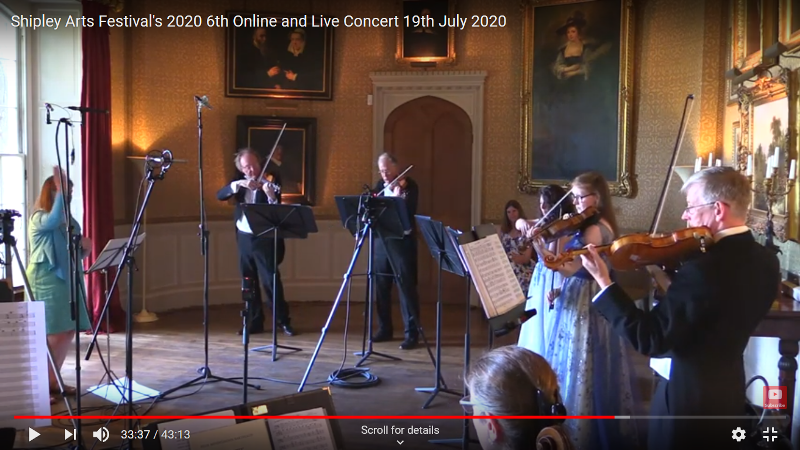
On Sunday 19th July 2020 Shipley Arts Festival broadcast their Wilding Concert on Zoom. It was the festival’s 6th concert to reach the audience via the internet during the COVID-19 pandemic. The concert included pre-recorded performances from three venues in and around Shipley in West Sussex.

I am really delighted to have been asked to write a new piece to celebrate the return of white storks to the UK after over 600 years and to have had the chance to work with the Shipley Arts Festival. The world premiere of my White Storks string octet came towards the end of the concert, filmed and recorded the previous weekend at the Knepp Estate in Shipley, where the storks have been re-introduced. The new octet was performed by members of the Bernardi Music Group and accompanied by dancer Vikkie Mead.

Now in it’s 20th year Shipley Arts Festival, led by violinist and artistic director Andrew Bernardi, is exhibiting an admirable doggedness and determination to keep going under difficult circumstances and is succeeding in entertaining and moving a growing audience at a time when we all desperately need creative and cultural stimulii. The whole concert can now be viewed on Andrew Bernardi’s You Tube channel. along with the previous 5 concerts of the 2020 festival.

The new commission has attracted some media interest with plugs on BBC Radio 3 and Classic FM as well as interviews on Radio Sussex’s Breakfast Show with Mark Carter (our interview is 1 hr and 50 mins into the show) and a magazine show, Local World which goes out weekly on two community radio stations in West Dorset: Abbey104 in Sherborne and KeeP106 in Dorchester (my interview with presenter Jenny Devitt and an extract of the new piece is 13 minutes into the 23/07 programme).

I am so grateful to all involved for giving me this wonderful opportunity. They are all named at the end of the concert film. Do take a look.

Of course now, I’m noticing storks everywhere – This morning I went to our drawer of postcards collected by both me and Steve over the last 40 or more years and the first one a picked up was this, produced by German postcard makers Editions Michel + Co in their Sundshine cards category. There definitely seems to be a story here – but what?…… if this rings any bells with anyone, I’d love to know.

Birds and music

Image by katja from Pixabay

In just over 48 hours we will be able to see and hear Shipley Art Festival’s Wilding Concert beamed across the globe via Zoom. Last Sunday the Bernardi Music Group and I gathered, physically distanced of course, at Knepp Castle to record my new commission, White Storks for String Octet. It was the most overwhelming experience – hearing what’s been going round in my head for weeks in reality for the first time. Thanks to the brilliant players and the excellent film and sound producers the piece was reheased and recorded from a standing start in about an hour and a half.

You can get your ticket by visiting the Shipley Arts Festival website and following ‘forthcoming events’ and 19th July or you can go straight to the eventbrite ticket page here.

Shipley Arts Festival have been broadcasting their concerts on YouTube and Zoom since the beginning of lockdown, refusing to give up the idea of sharing music with their friends and audience. In fact this way, people from far and wide can join in and it may be that some who have been unable to attend concerts for years suddenly find themselves among the audience. There are a few silver linings to the restricted world we find ourselves in.

Birds are a frequent source of inspiration for artists of all kinds, but music and dance seem to echo the kinds of words we use to describe the nature and behaviour of birds – flying, soaring, gliding, spiraling. In the first section of my new piece I am imagining the white storks near the end of their journey from Africa to Sussex, glimpsed in the distance, floating in the air, then as individual birds come into view you start to hear solo musical phrases which leap and dip. When we were recording – I explained that the way to play the phrases as I imagine them is to feel like a bird in flight, or a bird on the nest – the storks have a strange way of moving back and forth on the nest as though they can’t quite decide where to stand. The way a stringed instrument is played with the long sweep of the arm with the bow is perfect for this kind of visualisation. The 8 string players play in pairs, sometimes moving as one, sometimes more like a duet or one echoing the other. I’ve tried to write it as a very democratic piece to play. All the players have their moments.

Throughout the process I have been following The White Stork Project on social media and seeing the work of various photographers. I still haven’t seen the storks in real life so for now these amazing images are my reality. Last Sunday I met photographer Malcolm Green who has been following the progress of the White Storks at Knepp for the last 2 years. This is what he said about my new piece:

Your composition is beautiful and it resonated with me because I have watched and photographed the white storks at Knepp Castle Estate for 2 years and your music captures the magic and behaviours of these incredible birds. The white stork project is a re-introduction programme based in West Sussex and it is a wonderful advert for conservation. Your composition is perfect timing too as the first wild storks have successfully bred in the UK for the first time since 1416. For me, your music has now become the white stork project theme tune. Thank you! 

So please do join us on Sunday at 6.00 pm for the Shipley Arts Festival Wilding Concert and the world premiere of White Storks.

Off to Knepp

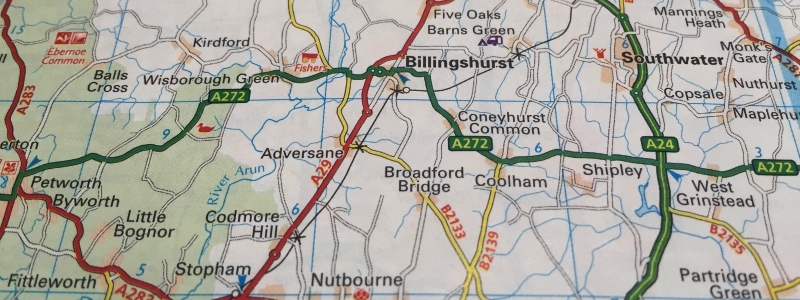
Tomorrow, Steve and I will be driving off cross country for the first time since the beginning of lockdown. We will be travelling on the iconic A272, subject of ‘A272: An Ode to a Road’ by Pieter and Rita Boogaart, heading for the Knepp estate in Shipley, West Sussex, where the Bernardi String Octet will be recording my new piece, White Storks.

Four of the octet are the members of the quartet who performed in Artmusic’s ‘In the Field’ in Wadhurst in May 2015 and played my ‘A Field in May’ so beautifully. This commission is a consequence of that collaboration and it will be great to be working with those players again.

This morning Andrew Bernardi and I were interviewed on BBC Radio Sussex. The White Stork Project and Shipley Festival’s innovative online concerts are attracting a lot of attention. This concert is special in that it brings together Knepp’s rewilding project and the storks with music and the local community which supports Shipley Arts Festival. This is all very rooted in Sussex but interest in rewilding and protecting endangered species is universal. Because of the online platform we hope the audience will be from across the globe.

The first of the stork chicks flew the nest on Thursday afternoon. The other chicks may be taking their first flights while we’re at Knepp, which would be very exciting to see. The first new stork life in Britain for 600 years. They are beautiful, engaging birds with great character and I feel very fortunate to have been asked to write music to celebrate their return to our landscape.

You can see video of the first chick’s first flight on instagram at @kneppsafaris and you can follow the progress of the storks by visiting the White Stork Project website. And to find out more about the concert on Sunday 19th July and to buy tickets visit the Shipley Arts Festival website.

Pencil and paper

White Storks parts 1
22 pages of parts for my new White Storks string octet

I have been promising myself for years that I will aquire and learn to use a music writing software package. And, thanks to a bit of emergency COVID19 funding from Arts Council England, I will be able to buy my preferred software and aquaint myself with the joys of digital music writing over a semi-locked down summer.

However, I am very much in two minds.  Sitting at the piano with a lovely soft pencil in my hand and blank manuscript paper on the music stand, I feel a bit like an artist poised, brush in hand, to make the first marks of a new painting. It’s not a part of the process that I want to move onto the computer. So sketching out initial ideas will definitely stay analogue.

If it’s an ensemble piece, as in the case of White Storks, even when the score is finished there are the parts to write.  A totally different kind of exercise – very practical – a matter of putting down each player’s notes in such a way that they will be able to understand what’s going on in the other parts without cluttering their page.

White Storks the right ruler

I get my tools together: a pencil, preferably B, a very good rubber and a ruler – I use my father’s old Gestetner ruler – the best ruler I’ve found yet.   In the vicarage in Wolvercote, when I was growing up, the Gestetner duplicating machine sat in the corner of the dining room.  My father would write the notices for the Sunday service by hand.  Then my mother would sit up on Saturday evenings typing them onto the very distinctive Gestetner stencils ready for feeding through the machine to print the sheets for the next day.  I would often come home after a Saturday night out to be welcomed by the ink smells and the machine noises of the Gestetner at work.  So the ruler which I have inherited must have come with the machine. Anyway, a ruler is essential. Hand-drawn note stems are fine but bar lines must be straight.

pencil and music paper

I noticed today after writing with it all week that the pencil I was using had the words ‘shadow play’ printed on the side. So actually it is a drawing pencil designed for creating light and shade – hopefully this is what I’ve been doing with it in some way.

Am I talking myself out of getting to grips with digital technology? No, I’m sure I will find ways to integrate modern ways into my practice, comfortably old-fashioned as it currently is. It’s strange really as, in my work with Artmusic, digital technology is an essential part of the production and presentation process.

Now my hand-written parts for White Storks have winged their way to Sussex and the members of the octet. On Sunday we will gather at Knepp Castle to perform the piece for the first time and record it for broadcast on Zoom the following week.

And meanwhile the source of the inspiration for the piece, the white storks, are busy. The first of the recently hatched chicks took it’s first flight yesterday afternoon. See @Kneppsafaris on Instagram for video footage. These are the first white storks born in Britain for 600 years. This young stork’s siblings will surely take their first flights over the coming days. The ambition is for there to be at least 50 breeding pairs in Southern England by 2030. Such a brilliant story to write music for. Such a privilege.

The Zoom virtual concert featuring my new piece is at 6.30 pm on Sunday 19th July 2020. For more info and links to tickets visit Shipley Arts Festival

For more information about the White Storks visit the White Stork Project